Blog

Creative AI: Composing Music, Writing Novels, and Designing Art (2025+)

Creative AI: Composing Music, Writing Novels, and Designing Art (2025+)

Creative AI: Composing Music, Writing Novels, and Designing Art (2025+) Artificial intelligence is rapidly evolving, and its creative applications are becoming increasingly sophisticated. By 2025, AI is poised to revolutionize how we approach music composition, novel writing, and art design. This article explores the current state of creative AI and offers insights into its potential future impact. The Rise of AI in Music Composition AI algorithms are now capable of generating original musical pieces in various styles. These AI composers can analyze vast libraries of existing music, understand patterns, and create new compositions that mimic or innovate upon established genres.

The Impact of Quantum Computing on Programming Languages (2030+)

The Impact of Quantum Computing on Programming Languages (2030+)

The Quantum Leap in Programming: Languages of the Future (2030+) As quantum computing transitions from theoretical possibility to practical application, its impact on programming languages is set to be transformative. By 2030, we anticipate a significant shift in how software is developed, requiring programmers to adopt new paradigms and tools. This post explores the evolving landscape of quantum programming languages and their implications for the future of computation. The Quantum Computing Revolution Classical computers, which power our everyday devices, store information as bits representing 0 or 1. Quantum computers, on the other hand, leverage quantum mechanics to use ‘qubits’. Qubits

May 18, 2025

Mathew

VR Headsets: Lighter, More Immersive, and Wireless (2025)

VR Headsets: Lighter, More Immersive, and Wireless (2025)

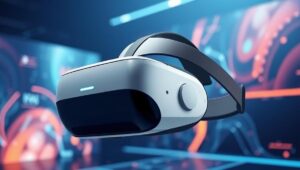
VR Headsets in 2025: A Glimpse into the Future The virtual reality (VR) landscape is rapidly evolving, and by 2025, we can expect significant advancements in VR headset technology. The focus is on creating lighter, more immersive, and wireless experiences. Let’s dive into the key areas of development. Lighter Designs for Enhanced Comfort One of the most persistent issues with current VR headsets is their bulkiness and weight. By 2025, manufacturers will likely have made significant strides in reducing the weight of VR headsets. This will be achieved through: Improved Materials: The use of lighter, yet durable, materials like carbon

May 18, 2025

Mathew

The Role of 5G in Powering Real-Time IIoT Applications (2025+)

The Role of 5G in Powering Real-Time IIoT Applications (2025+)

The Role of 5G in Powering Real-Time IIoT Applications (2025+) The Industrial Internet of Things (IIoT) is revolutionizing industries by connecting machines, sensors, and systems to enable data-driven decision-making and automation. However, many IIoT applications require real-time communication and ultra-reliable, low-latency connectivity, which traditional network technologies often struggle to provide. 5G, the fifth generation of wireless technology, is poised to overcome these limitations and unlock the full potential of real-time IIoT applications. What is 5G, and Why Does it Matter for IIoT? 5G is more than just a faster version of 4G. It’s a fundamentally different network architecture designed to

May 18, 2025

Mathew

Explainable AI for Security Operations Centers (SOCs) (2027)

Explainable AI for Security Operations Centers (SOCs) (2027)

Explainable AI for Security Operations Centers (SOCs) (2027) In the rapidly evolving landscape of cybersecurity, Security Operations Centers (SOCs) are facing increasingly sophisticated and high-volume threats. Artificial Intelligence (AI) has emerged as a crucial tool in augmenting SOC capabilities, automating threat detection, and improving incident response. However, the adoption of AI in SOCs comes with its own set of challenges, particularly the need for transparency and understandability. This is where Explainable AI (XAI) becomes essential. By 2027, XAI is poised to transform SOC operations, providing security analysts with the insights needed to trust and effectively utilize AI-driven security solutions. The

May 18, 2025

Mathew

RISC-V's Ascent: The Open Standard Reshaping Computing (2025+)

RISC-V’s Ascent: The Open Standard Reshaping Computing (2025+)

RISC-V’s Ascent: The Open Standard Reshaping Computing (2025+) The world of computing is on the cusp of a significant shift, driven by the rise of RISC-V (pronounced “risk-five”). Unlike proprietary architectures like x86 and ARM, RISC-V is an open standard instruction set architecture (ISA) that is poised to revolutionize how we design and utilize processors across a multitude of applications. This article will delve into the key aspects of RISC-V, exploring its potential impact on the future of computing, particularly as we move beyond 2025. What is RISC-V? At its core, RISC-V is an open-source ISA. This means that its

Visual Programming Languages: Beyond Scratch for Professionals? (2028)

Visual Programming Languages: Beyond Scratch for Professionals? (2028)

Visual Programming Languages: Beyond Scratch for Professionals? (2028) Visual programming languages (VPLs) have long been considered tools for beginners, particularly in educational settings. Scratch, with its drag-and-drop interface, has been instrumental in introducing coding concepts to countless students. But as we approach 2028, the question arises: Can VPLs transcend their beginner-friendly image and find a place in professional software development? The Evolution of Visual Programming VPLs aren’t new. They’ve been around for decades, evolving from simple flowchart-based systems to sophisticated environments capable of complex logic. Early examples include Prograph and LabVIEW. However, their adoption in mainstream professional settings has been

May 17, 2025

Mathew

AR Glasses: The Smartphone Replacement by 2030?

AR Glasses: The Smartphone Replacement by 2030?

AR Glasses: The Smartphone Replacement by 2030? The tech world is abuzz with the potential of augmented reality (AR) glasses. Envision a world where digital information seamlessly overlays your view of reality, offering a hands-free, intuitive way to interact with technology. Could these sleek devices replace our beloved smartphones by 2030? Let’s delve into the possibilities and challenges. What are AR Glasses? AR glasses are wearable devices that overlay computer-generated images onto the real world. Unlike virtual reality (VR), which immerses you in a completely digital environment, AR enhances your existing surroundings. Think of it as having a transparent display

May 17, 2025

Mathew

Worker Safety in IIoT Environments: Wearables and Alerts (2025)

Worker Safety in IIoT Environments: Wearables and Alerts (2025)

Worker Safety in IIoT Environments: Wearables and Alerts (2025) The Industrial Internet of Things (IIoT) is transforming workplaces, promising increased efficiency and productivity. However, this digital revolution also introduces new safety challenges. This article explores how wearable technology and alert systems are crucial for ensuring worker safety in evolving IIoT environments, focusing on the advancements expected by 2025. The Rise of Wearable Technology in Industrial Safety Wearable devices are no longer limited to fitness tracking. In industrial settings, they are becoming sophisticated tools for monitoring worker health, location, and environmental conditions. These devices can track vital signs, detect falls, and

May 17, 2025

Mathew

The Ethics of AI in Cybersecurity: Bias and Autonomous Decisions (2025)

The Ethics of AI in Cybersecurity: Bias and Autonomous Decisions (2025)

The Ethics of AI in Cybersecurity: Bias and Autonomous Decisions (2025) Artificial intelligence (AI) is rapidly transforming the cybersecurity landscape. AI-powered tools are now used for threat detection, vulnerability assessment, and incident response. However, the increasing reliance on AI in cybersecurity raises critical ethical concerns, particularly regarding bias and autonomous decision-making. The Double-Edged Sword of AI in Cybersecurity AI offers significant advantages in cybersecurity: Enhanced Threat Detection: AI algorithms can analyze vast amounts of data to identify patterns and anomalies indicative of cyberattacks, often more quickly and accurately than humans. Automated Incident Response: AI can automate responses to common cyber